Monday, July 14, 2008

July Pride and Points Tournament

Mike Carrel (founder of the Carrel Chess Club) hosted a 5 round G/30 tournament Saturday, July 12th. The tournament was the second monthly action tournament for the Carrel Chess Club.

Here are some random observations:

1. 20 people showed up on a Saturday when there was a competing tournament in Toledo
2. Of the 20 players who played on 7/12/08, 8 were new to tournament play at CCC
3. 11 players ratings increased an average of 62.8 points each
4. 8 players ratings decreases an average of 36.8 points each
5. The 19 players gained an average of 21 points each
6. 1 player played his first tournament

Congratulations to the top 2 ratings gainers (both gained over 100 points)!
1. Alan Sun gained 341 points!
2. Mandy Lu gained 171 points

Alan Sun broke the CCC record of points gained in a single tournament. The old record had been set by John Zhang with 300 points at the June 28th Action.

Mandy Lu has gained over 100 points in both tournaments, and has now gained 325 points in 15 calendar days! Also, she is the only 2 time member of the 100 point club.

The complete 100 point club is:
1. Alan Sun 341 pts 7/12/2008
2. John Zhang 300 pts 6/28/2008
3. Jacob Schneider 188 pts 6/28/2008
4. Mandy Lu 171 pts 7/12/2008
5. Mandy Lu 154 pts 6/28/2008
6. Rodney Dison 141 pts 6/28/2008

Of note: The cumulative ratings gain from this tournament was 400 points, which lagged behind the 449 total points gained by the field in the 6/28/08 tournament.

Sunday, June 29, 2008

June Pride and Points Tournament

Mike Carrel (founder of the Carrel Chess Club) and I teamed up to run a 5 round G/30 tournament yesterday, June 28th. The tournament was the christening tournament for the Carrel Chess Club in its new permanent location.

Here are some of the highlights as I see them:

1. 28 people showed up for the inaugural tourney
2. We were only 15m behind schedule in spite of a printer problem
3. In the top section:
--- 9 player ratings increased with an average gain of 43 pts each
--- only 5 players ratings dropped with an average loss of 36.8 pts each
4. In the bottom section:
--- 7 players played their first rated tournament (average rating 324)
--- 3 players ratings increased an average of 214 pts each
--- 4 players ratings decreased an average of 23 pts each
--- 1 player graduated from provisional

Congratulations to the 4 biggest ratings winners (all of them were up over 100 points):
1. John Zhang gained 300 points!
2. Jacob Schneider gained 188 points
3. Mandy Lu gained 154 points
4. Rodney Dison gained 141 points

Additional congratulations to:
1. Manmohan Das for winning the open section with 4.5/5
2. John Zhang for winning the U700 section with 4/5!
3. Joy Chen for the biggest upset of the day. Joy won her first game in spite of a deficit of 537 rating points!

Wednesday, March 05, 2008

Snow Day Chess: Part 3

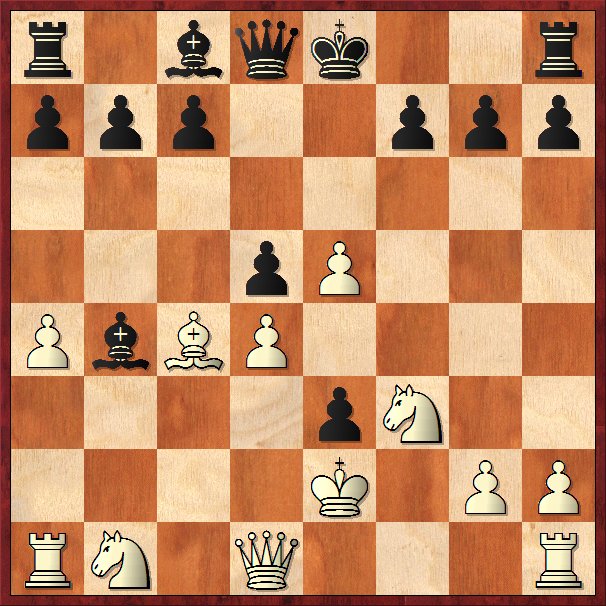
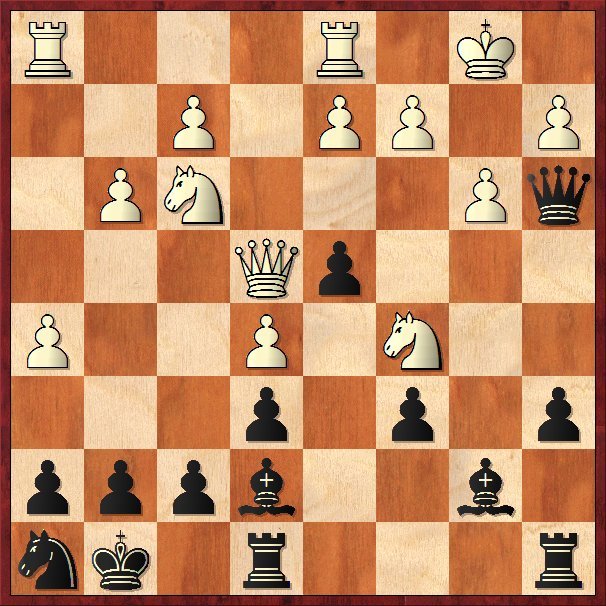
This position came up in a 5 minute game I played today. I missed the winning combination. Black to move and win.


Snow Day Chess: Part 2

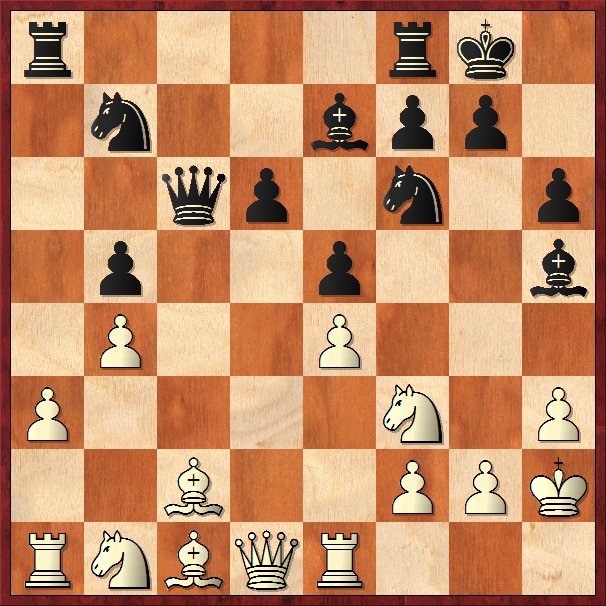
In this position I was black and had worked my opponent into a corner. At this point I I had mate in 4. I played the first 2 moves right, and then botched the mate in 2 and lost in the end.


Snow Day Chess

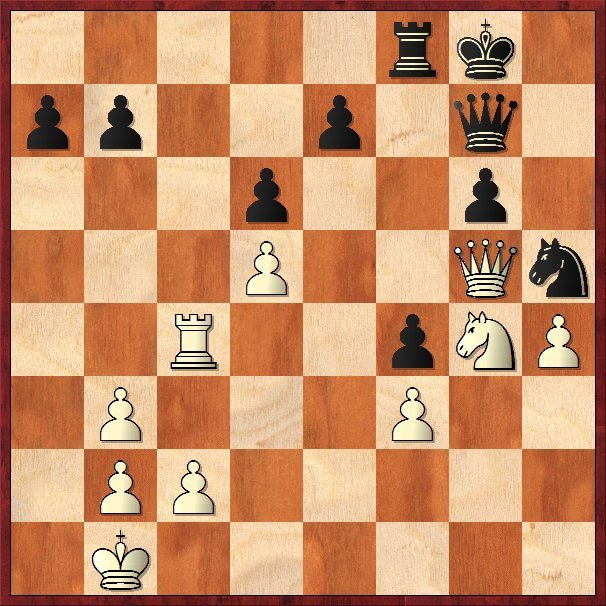
Since my school had a snow today, I had the day off and decided to get in some chess games this morning. This position came up in a 5 minute game, where I was black. It is black to move and mate in 4.


I missed the mate in 4, and instead found mate in 5.

Saturday, August 18, 2007

2007 MCA Class A Championships- R1

Prong,C (1840) - Jarosz,S (1959)
2007 MCA Class Championships (1), 13.01.2007
Sicilian Defense: Scheveningen Variation [B80]

1.e4 c5 2.Nf3 e6 3.d4 cxd4 4.Nxd4 Nf6 5.Nc3 d6
This is the Scheveningen Variation of the Sicilian Defense. I had recently decided to stop playing the Keres Attack because I had not been scoring well with it, but I hadn't found time to learn another line yet.
6.Be3 Be7 7.f3 Nc6 8.Qd2 a6 9.Bc4
Typically this bishop is placed on d3, but on c4 the bishop will have to retreat after Qc7.
9...0-0 10.0-0-0 Qc7
In typical Sicilian fashion kings are castled on opposite sides of the board. Black typically attacks with queenside pawns, meanwhile white attacks with a kingside pawn storm.
11.Bb3 b5 12.g4 Nxd4 13.Bxd4 Nd7 14.h4 Nc5 15.g5 Bb7 16.h5 Nxb3+ 17.axb3 Rac8 18.Rdg1
White needs to tear open a line on the kingside and should probably wait to bring the second rook to the kingside. Playing h6 forces g6, which weakens the dark squares around the black king. Then Bf6 practically forces black to trade bishops and allows white to open the g-file with gxf6.
18...e5 19.Be3 d5
Threatening a pawn fork on d4.
 

20.exd5
Nxd5 was correct here, and white maintains a slight edge.
20...Bb4
This is the move that white overlooked. The c3 knight is attacked 3 times now, but defended only twice.
21.Kb1
White really doesn't have time for this. The best defense to your opponent's attack is frequently counterattack. Therefore, g6 is correct, as it forces open lines in front of the black king. White would then have compensation for his pawn defecit. 21...Bxc3 22.bxc3 Qxc3
White is about to go down a pawn. Therefore, I followed the axiom of not trading pieces when behind, and thereby chose to keep the queens on the board. 23.Rh2 Bxd5 24.Qxd5 Qxe3 25.Rhg2 Rfd8 26.Qb7
White is still trying to find ways to keep the queens on the board in hopes for finding drawing chances.
26...Rb8 27.Qc6 Rdc8 28.Qd6 Qxf3 29.Qxe5 Re8
Black determined that taking the h5 pawn was dangerous while the white queen was on the b8-h2 diagonal, as Rh2 and Rgh1 might come next.
30.Qd6 Rbd8 31.Qc7 Rc8
Qxh5 winning another pawn or Rd1+ followed by a rook trade or Qxh5 are both preferable here.
32.Qh2 a5 33.g6 fxg6 34.hxg6 h6 35.Rf2 Qe4 36.Qd6 a4 37.Qd7 axb3 38.Qf7+ Kh8 39.Qxb3 Re6 40.Rgf1 Rxg6
Qxg6 and black is two pawns up with every chance of winning. Black was under 10 minutes left on his clock when he played this horrible blunder.
 

41.Rf8+ Rxf8 42.Rxf8+ 1-0

Saturday, August 04, 2007

2007 MCA Class A Championships

This was the last big event I played, so I have been very inactive this year. Hopefully, I will find time to study and regain the energy and drive to resume my pursuit of moving through Class A on to Expert. My rating descended 2 points from 1840 to 1838 after scoring 2/5 with wins over Stan Jarosz and Zoran Stojanovski. I was disappointed in my score. I was hoping for a plus score, but -1 isn't that bad since this was my first chance to play in a Class A event.

Sunday, November 12, 2006

Metro League 2006- R2

Prong,C (1852) - Dishman,M
2006-2007 Metro Chess League (2),
All the King's Men, Warren, 10.27.2006
King's Gambit Accepted [C34]

1.e4 e5 2.f4 exf4 3.Nf3 Nc6
To quote GM Gallagher, "This move has never really caught on, probably because it does little to address black's problems.
4.d4 Bb4+?
This can't be good since it allows white to build his pawn chain with tempo. Black should try d5, and then on exd5 he plays Qxd5 and has himself developed a piece with tempo.
5.c3 Ba5 6.a4
A cute trap that I should have resisted playing. White is hoping to get in b4 and then a5 where blacks dark squared bishop is trapped. The simple Bxf4 is probably best for white.
6...Nf6 7.e5
White continues to build his pawn chain with tempo.
7...Nd5 8.Bc4
White tries to keep black busy so that he can work in his trap.
8...Ne3 9.Bxe3 fxe3 10.b4 Nxb4
Black will get two pawns for the knight (three pawns if you count white's gambit pawn) and leave white with a fractured pawn structure. In addition, black will have only one piece developed.
11.cxb4 Bxb4+
Fritz rates it equal, but as I heard Ben Finegold say once, "A piece is worth a million pawns."
12.Ke2 Blocking the advanced pawn.
12...d5?


13.Qb3
White continues to find ways to develop and thereby gains tempo or material. 13...Ba5 14.Bxd5
White regains one of his lost pawns.
14...0-0 15.Na3 Bd2 16.Nc2 Bg4 17.Bxb7
Now white has regained a second pawn
17...Rb8 18.Qd5 Qe7 19.Rab1 Be6 20.Qe4 g6?
This move is probably unnecessary. It would have been better to keep improving the position. i.e. c5 and black is making threats to win the Bb7.
21.Nxe3 Bf5
Black needlessly gives away another pawn here.
22.Nxf5? gxf5 23.Qxf5 Bh6 24.Qh5 Bg7
I wanted the black bishop here so that the queen would not protect h7 when black moved the f-pawn.
25.Be4 f5 26.Bd5+ Kh8 27.Ng5 Bxe5
I totally missed this move, but as it turns out... it didn't matter anyway.
28.Nf7+ Rxf7 29.Rxb8+ Kg7 30.Qxf7+
Ending any hopes black had of winning material with a discovered check. 30...Qxf7 31.Bxf7 1-0

Thursday, May 18, 2006

2006 Apr. Toledo Swiss- R4

Hyslop,N (1648) - Prong,C (1904)
2006 April Toledo Swiss, 4.8.2006
Spanish Opening: Bogolyubov Variation [C91]

1.e4 e5 2.Nf3 Nc6 3.Bb5 a6 4.Ba4 Nf6 5.0-0 b5 6.Bb3 Be7 7.Re1 0-0 8.c3 d6 9.d4 Bg4 This is the Spanish Bogolyubov variation
10.d5 Na5 11.Bc2 h6
I was out of book at this point. The book move was c6.
12.b3
The aim of the move is to take away c4 from the a5 knight. At the same time though, this seriously cramps the white light squared bishop, which was already bad due to the d4 pawn.
12...Bh5 13.h3 Qc8 14.Kh2 Nb7 15.b4
While this move does hamper the b7 knight, it also creates a weakness on c3.
15...a5 16.a3 axb4 17.cxb4
Black really had no way to get at the c3 pawn immediately, so instead he turned to opening lines for his rook.
17...c5 18.dxc6 Qxc6
The contrast between white's rooks and queen couldn't be any greater. The black queen is active on both an open file and diagonal. Both of whites rooks are defensively postured, meanwhile the black rooks stand ready to fire down the half open a-file or the open c-file.


19.Bb2 Qb6
I considered Bxf3 because the queen cannot recapture on f3. Therefore, the white king's pawn shield would be shattered.
20.Qe2 Nd8 21.Nbd2 Ne6
The once useless knight on a5 has been redeployed and now stands poised to jump to either d4 or f4.
22.g3 Rfc8 23.Bb3 Ng5
This move forces another pawn move in front of the white king.
24.g4 Nxf3+ 25.Qxf3 Bg6 26.Rac1 Nh7
The knight prepares to move forward to g5.
27.h4?
An oversight on the part of the white player. He missed the bishop perched on e7 controlling the h4 square.
27...Bxh4 28.Qg2?
White could have prevented the immediate loss of the f2 pawn with Rxc8+ or Kg2. 28...Bxf2 29.Rf1 Be3 30.Rcd1 Ng5 31.Bd5 Ra7 32.Nf3?
White gives away another pawn. Nb3 or Nb1 would have been better.
32...Bf4+ White has seen enough carnage and resigns. 0-1

Wednesday, May 17, 2006

2006 Toledo May Swiss

I took a carload of players down to Toledo for the May Swiss, since I can't afford the $70 entry fee that Ed Mandell charged for his 2 day tournament this weekend. The other players with me either had the same complaint about the cost, or they were unavailable for 2 day of chess. Anyhow, the tournament is rated already.

I scored 2/4 with wins against Michiganians Scott Rogers and Loren Schwiebert, winning with white and then black respectively in the first two rounds. I lost games 3 and 4 to Paul Maginley with white and then John Gattinger with black. Incidentally, I missed tactics in both games that allowed me to get checkmated. I will post those games before too long with annotations.

The other guys with me were: Al Foord 2/4 +0, Loren Schwiebert 2/4 -17, and my brother Paul Prong 2/4 +90. My brother played 4 people rated at least 200 points above him in each game and scored magnificently against tough competition. This brings his rating up to 1324, and more in line with his actual skill level.

Finally, it seems my scoresheet is not accurate enough to reconstruct my April game against Nathaniel Bromberg. This is only the 2nd time in 231 USCF rated games that this has happened to me. If I am able to get a hold of his scoresheet, then I will post the game with annotations at a later date.

Tuesday, May 16, 2006

2006 Apr. Toledo Swiss- R3

Prong,C (1901) - Carter,A (1836)
2006 April Toledo Swiss, 4.8.2006
Caro-Kann Defense: Advance Variation [B12]

1.e4 c6 2.d4 d5 3.e5 Bf5 4.Nf3 e6 5.Be2 Nd7 6.0-0 Ne7 7.c3 c5 8.Be3
Benjamin played 8. dxc5 against Seirawan in the 1991 US Championships. MCO scores that line +-
8...Nc6 9.a3 c4 10.Nbd2 b5 11.b4 a5 12.Re1 a4
I must admit, I really didn't expect Ashley to close off the queenside. However, her plan is now clear. She intends to castle queenside and shelter her king behind that wall of pawns.
13.Nf1 Be7 14.Ng3 Bg6 15.h3 Qc7 16.Qd2 0-0-0 17.Bf4 h6
I was now seeking a plan. Ashley's king was safely locked away on the queenside. I needed to get my rooks into the game, however there were no open files. Therefore, I decided to temprarily move my king to h2, bring the king back to the queenside by hand, and then march my kingside pawns up the board with the rooks behind them. This is a very slow developing plan, but in a closed position like this there is much more time for positional maneuvering than in open games.
18.Kh2 Rdg8 19.Rh1 Bd8 20.Kg1 Ne7
At this point I realize that I have to consider the possibility that the e7 knight is coming to the f5. At that point, I expected that the knights would be traded off. 21.h4 Nf5 22.Kf1 Nxg3+ 23.Bxg3
With the capture by the bishop on g3 I maintained a solid kinside pawn structure, although if my king was more secure, then I probably would have looked to open the f-file.
23...Bh5 24.Ke1 Be7 25.Ng1 Bxe2 26.Kxe2
With the king perched on e2, I finally have room to bring my a1 rook over to the kingside and join in the impending attack. 26...g6 27.Bf4 h5 28.Nf3 Nf8 29.Bg5 Bxg5 30.Nxg5 Qe7?
This loses a pawn. Nh7 would have held.
31.Qf4 Kd7 32.Nxf7 Rh7 33.Nd6 Kc6 34.Rh3 Nd7 35.Qg5
In retrospect, I don't like this idea. After hxg5 there is no place for the white king to penetrate the black position.

Now the white king has no entry point into the black position.
35...Qxg5 36.hxg5 Rhg7 37.Rah1
I think Rg1 was more accurate as it lends support to the pushing and trading of the doubled g2 pawn.
37...Nb6 38.Rf3 Nc8 39.Nxc8 Rxc8 40.Rf6 Kd7 41.Kf3
The king belonged on e3 if I was going to move it as I needed to push both the f-pawn and g-paw. So on f3 it is in the way.
41...Rh8 42.Rh4 Ke7 43.Kf4 Rhg8 44.g4 hxg4 45.Kxg4 Re8 46.Rh2 Reg8 47.Rf3 Kd7 48.Rh6 Ke7 49.Rfh3 Kf7 50.Kg3 Kf8 51.Kh4 Kf7 52.Kg4 Kf8 53.Rf3+ Ke7 54.Rf4 Kd7 55.Kg3 Ke7 56.f3 Kd7 57.Rfh4 Ke7 58.Rh8 Kf7 59.Rf4+ Ke7 60.Rh6 Kd7
I allowed this draw with about 2 minutes left on my clock. However, with time white may still be able to play for a win. The idea would be to play Rf6 and then move the white king off the g-file. Next, white would play f4 and sacrifice the f-pawn on f5. This would open up play for a rook battery for white along the 6th rank.
½-½

Sunday, May 14, 2006

2006 Apr. Toledo Swiss- R1

Prong,C (1903) - Amarasinghe,P (1287)
2006 April Toledo Swiss, 4.8.2006
King's Gambit Accepted: Schallop Defense [C34]

1.e4 e5 2.f4 exf4 3.Nf3 Nf6 4.e5 Nd5
This move deviates from the book line, which is Nh5 (a position deemed equal).
5.Bc4 Nb6 6.Bb3
From b3 the white bishop temporarily dominates the b6 knight.
6...Be7 7.0-0 0-0 8.d4 d5 9.Qd3
White should probably have played Bxf4.
9...c5 10.c4?
White drops a pawn with this line. After dxc5 white can maintain equality.
10...dxc4 11.Bxc4 Nxc4 12.Qxc4 Be6
An excellent idea. Black develops with tempo, and takes a nice lead in development to accompany his lead in material.
13.d5 Qxd5 14.Qxf4 Nc6
Black spots a weakness and piles on attackers against the e5 pawn.
15.Nc3 Qc4 16.Qg3
Black is only a pawn ahead, and I can probably get the pawn back later. Still the old mantra is to trade pawns when you are behind, and pieces when you are ahead. So i decline the exchange of queens.
16...Qg4 17.Qf2 Nd4
An intriguing idea was f6 threatening to unleash a rook down the f-file against the queen.
18.Nxd4 Qxd4 19.Be3
Black is succeeding in trading off pieces, and now he adds another pawn to his lead as I choose to decline another offer to exchange queens. White could have held onto the pawn with either Bf4 or Qe3.
19...Qxe5 20.Rfe1 Rfd8
Black can igonre the potential discovered attack on his queen for now. 21.Rac1 b6 22.b3 Qf6 23.Qe2
The battery Qe2 sets up a potential discovered battery attack down the e-file 23...Qg6 24.Qf3 Rab8 25.Nb5 Bd5 26.Qh3 a6
Black has left a piece unprotected. That signals an alert to look for combinations. 27.Bf4
Black has to calculate carefully now. He can hold his lead with Bg5 or Be6.


27...axb5
However, he could not afford to take the knight on b5. White will not only equalize now, but take a small lead.
28.Bxb8 Be6 29.Qg3 Qxg3 30.Bxg3
White is now up an exchange for a pawn.
30...Rd2 31.Bc7 Rxa2 32.Bxb6 Rb2 33.Bxc5 Bg5 34.Be3 Bxe3+ 35.Rxe3 g6 36.Rc5 Rxb3 37.Rxb3 Bxb3 38.Rxb5
White has miscalculated. He still holds a slight lead, but black will be able to build a fortress. The key in this position is that the bishop will be able to protect the black pawns because they are all on the light squares. Furthermore, the rook has no entry points into the black position.
38...Be6 39.Kf2 h5 40.Ke3 Kg7 41.Kf4 Kf6 42.h3 Bc4 43.Rb6+ Be6 44.Ra6 Kg7 45.Ke5 Bc4 46.Ra7 Bf1 47.Ra2 Bc4 48.Rf2 Bb3 49.Kd6 Bc4 50.Ke7 Be6 51.Rf4 Bd5 52.g3 Be6 53.g4 hxg4 54.hxg4 Bd5 55.g5 Be6 56.Rd4 Bb3 57.Rd6 Bc4 58.Rf6 Bd5 59.Kd6 Bc4 60.Ke7 Bd5 61.Rd6 Bc4 62.Rc6 Bd5 63.Rd6 Bc4 64.Rb6 Bd5 65.Kd6 Be6 66.Ke5 Bc4 ½-½

Sunday, April 23, 2006

K-12 Championship Final Standings

2006 K-12 Championship Final Standings for Michigan Players
21 KAHN, AARON E 11 MIBERK MI 2177 5.5
51 WILDER, DEREK 12 MID002 MI 1711 5
67 CARTER, ASHLEY 10 MIMONR MI 1836 4.5
96 RAMAKRISHNAN, KALYA 12 MIMONR MI 1251 4.5
100 CANTY III, JAMES 12 MIBATE MI 1823 4
166 WILLIAMS, MARCUS 11 MIMURR MI 1615 3.5
186 PAULOVICH, GERALD KEVIN 12 MIMONR MI 1591 3.5
204 SMELCER, COLLIN 9 MIMONR MI 1261 3.5
221 CHAUDHURY, ISTHIER 11 MIE001 MI 1526 3
259 HOFFMAN, THOMAS 10 MIMONR MI 1275 3

Tactics from Derek Wilder


Derek Wilder (1711) played a sensational tournament at the National K-12 Championships finishing with 5/7. This is a position from his 7th round game against Daniel Rohde (1891). Here Derek is white and black is about to play Rf5 trapping the white queen. How did Derek save this position?

Saturday, April 22, 2006

BND match vs. Eli Rogers

Rogers,E - Prong,C (1904) [C57]
Brand New Day Cafe, 04.20.2006
Two Knight's Defense: Ulvestad Variation [C57]

1.e4 e5 2.Nf3 Nc6 3.Bc4 Nf6 4.Ng5 d5 5.exd5 b5 6.Nxf7?
Clearly white had better options. Surprisingly, Bf1 is the book response here. 6...Kxf7 7.dxc6+ bxc4
For the knight sacrifice, white has gotten 2 pawns. Furthermore, he has fractured the black queenside pawn structure and destroyed black's hope of castling. However, the pawn on c6 is not long for this game, and the lead that black has in development will not be going away anytime soon.
8.0-0 Qd5 9.Nc3 Qxc6 10.d3 cxd3 11.cxd3
Forced. On Qxd3 comes Ba6 with a skewer of the white queen and rook. I struggled with this move. I knew I wanted to develop a bishop, but finally I decided that Bc5 was stronger because it pinned the f2 pawn.
11...Bc5 12.h3 Bb7 13.Ne4
Taking the e4 knight looked scaryto me because after dxe4 the black king is exposed and the white queen has access to the d-file, in addition to the b3, f3 and h5 squares for potential checks.
13...Rad8
Pinning the d3 pawn, and causing the knight on e4 to become unprotected.
14.Ng5+ Ke7 15.Nf3 Rhe8 16.Bg5 Kf8 17.Be3 Bxe3 18.fxe3 Ba6
Now on Rc1 black plays Qb6, and will threaten the fork of the b2 and e3 pawns, in addition to winning the d3 pawn.
19.Ng5 Kg8
I looked at Bxd3, and it looked very good. However, I decided to get my king tucked away and play it safe, since I was ahead.
20.Rc1 Qb6 21.Re1 Rxd3 22.Qa4 Rxe3 23.Kh1 Rxe1+ 24.Rxe1 Qb5
Since black is up a piece and a pawn it is time to trade off the queens, which should remove most of the drawing chances that white might find.
25.Qa3 Qc6
This move has two purposes. On the surface it seems like it is simply an attempt to control the h1-a8 diagonal and pin the g2 pawn to the king. While that is true, it also has the added benefit of helping to control the square directly in front of the passed pawn. White now hits e4 2 times and gains control of the square so that the e pawn may be pushed one stepped closer to the promised land.
26.Nf3 e4
I wanted to play this move right away, but it is improtant to examine what you give up when you remove a piece from one square to move it to another. In this case I relinquished control of the d4 square. I decided this wasn't critical because I could move my queen to d6 with a gain of tempo, since white probably did not want to trade queens.
27.Nd4 Qd6 28.Qa4 e3 29.Nf5 Qd3
Protecting both the pawn on e3 and the bishop on a6. Furthermore, the queen attacks the knight on f5.
30.Nd4 Re4 31.Rd1


Rxd4
Temporarily giving back some material, but this is inconsequential since black will promote his pawn, and win the game.
32.Qxd4 Qxd4 33.Rxd4 e2


With no hope of stopping the pawn from queening. 0-1

Friday, April 21, 2006

Black to move: Mate in 4


This position comes from a G15 OTB game I played today. Can you find the combination?

Thursday, April 20, 2006

BND match vs. Bob Mayer

Mayer,B (1045) - Prong,C (1798)
Brand New Day Cafe, 03.09.2006
Sicilian Defense: Closed Variation [B23]

1.e4 c5 2.Nc3 Nc6 3.Bb5
g3 and f4 seem to be the more common book lines for white. NCO does list Bb5 as an intersting sideline.
3...a6
Nd4 was the accurate response I didn't find.
4.Bxc6 bxc6
I captured towards the center in hopes of opening the center later with d5 and undoubling my c-pawns.
5.Nf3 e6 6.b3 d5 7.e5 Ne7 8.Ba3 Ng6 9.g3 Be7 10.h4
White is hoping to force the knight back to the eighth rank.
10...Qc7 11.Qe2 0-0?
While not losing material straight away, this seemingly logical move allows white to kick the g6 knight to h8, a horrible post for a knight.
12.Na4 Qa5 13.Qe3
h5 is still a better choice. It forces the retreat of the g6 knight to h8, and nearly stables the poor horse there permanently.
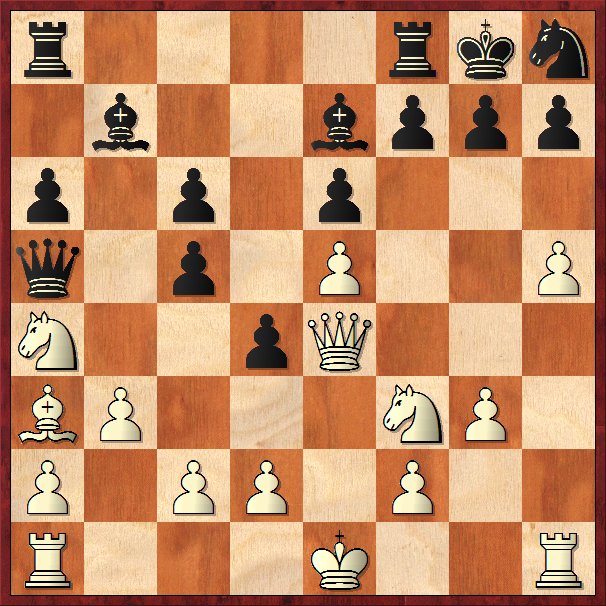
13...d4 14.Qe4 Bb7 15.h5 Nh8 16.0-0-0?
Missed tactic here. Nxd4 cxd4 allows white to win a pawn after Bxe7.
16...Rfe8 17.Nxc5
A terrible blunder.
17...Qxa3+ 18.Kb1


Bxc5
A positional error. The black bishop was controlling the critical g5 square. Now black will have to defend a fierce white attack.
19.Ng5 g6 20.hxg6 Nxg6 21.Nxh7
White gains tempo with Rxh7, because he needs to lift the h1 rook anyway to gain space for Rdh1. Sure the knight fork on f6 is good if white can get it in, but there is truly no chance that a good player will not find an adequate defense for that. 21...Kg7 22.Nf6 Rh8 23.Nh5+ Kf8
Black now has the option of fleeing with his king to the queenside if need be.
24.d3 Rd8
Preparing Bb4 followed by Bc3 and Qb2#
25.f4 Bb4 26.c3 dxc3 27.Rc1??
Qe2, Qg2 and Rh2 all allow white to play a few more moves.
27...Qb2# 0-1

Sunday, April 09, 2006

2006 April Toledo Swiss

There was a good turn out today. There were 24 players in all, and a total of 5 in class A. Will Rhee shared first place with 3.5/4, and I shared the Class A Prize with John Gattinger and Ashley Carter, as we all score 3/4. I played Ashley to a draw, although I was up a pawn. I'm certain there was a way to win the game before I traded off queens. I will analyze the game sometime this week and post my analysis.

Tuesday, April 04, 2006

Rapid Tactics


I was playing white in this 5 minute game. It is black to move. He plays b6. How did I take advantage?

Saturday, March 25, 2006

Missed Tactic from Mayer-Prong 3/2/06


This is a position from Mayer-Prong at BND Cafe on 3-2-06. White missed an opportunity to win material here. What should white have played?